
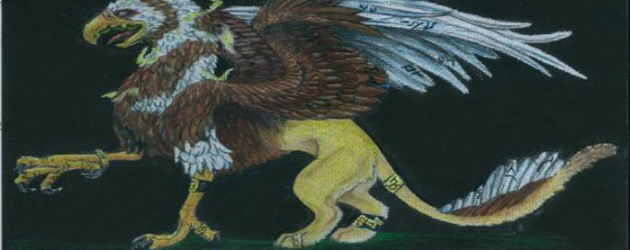
Gryphon
Gryphons are the powerful byproduct of an ancient shadow war between the gods and the primal spirits. A melding of divine and primal powers, they resemble an artful combination of feline and fowl – most notably, lion and eagle.
Gryphons were created in several spheres of influence, with diverse missions in the world to manage the flow of divine energy. Whatever their goals, gryphons pursue them with a single-mindedness that contradicts their dual nature.
History
When the Dawn War finally concluded, a stalemate was called between the primordials and the gods. The primal spirits, strengthened by numbers and the power of the world itself, decided that no side would win the war, despite how nearly the gods had come to victory, and moved to claim the domain as their own.
Long considering the primal sprits to be allies, the gods were caught unaware by the sudden turn. As beings of reason and logic, the furious assaults by the spirits against both sides appeared to be madness to them, and, at first, the gods resisted. However, it quickly became clear to the gods that the world would not survive the death of its spirits and withdrew.
A Loss of Power
Cast from the world they had saved, the gods were left to stew in the broken terrace of the Astral Sea. Weakened and dwindling in numbers, the gods had paid a dear price with the end of the war. Powerful artifacts remained behind, and the gods’ relations with their followers became distant quickly. Further, in order to keep the world safe from divine and elemental tampering, the primal spirits created guardians that would hunt down foreign powers and destroy them.
These creatures, called arimaspi, were powerful and beautiful in form, but despicably cruel and ugly in spirit. Frightfully efficient, these one-eyed creatures forever hunted divine and elemental energies, which they could reform into gold – the substance they desired above all else. In time, the gods feared, the spirits might reduce them to the power they had held long before the Dawn War. They dared not imagine what would occur in their realms if this came to pass.
But the prayers of their followers did not cease to call for aid, and the gods could not stay idle for long. To most, the situation was hopeless. Warded from the world, the gods knew they would never walk the earth again. In these conditions, their worshippers would hardly last a single generation.
To an immortal being, such a length of time was infinitesimal – and utterly terrifying.
Ortenz’s Plan
The betrayal of the primal spirits was still fresh in the god’s collective divine minds, leading most to initially despise them. Angelic armies patrolled the border of the worlds, and were commanded to destroy the spirits if they crossed the threshold. In the end, though, the gods would not assault the world for fear of destroying it. Vengeance, however, was an acceptable topic and indeed the common tongue of the Astral Sea for years.
Furious at his drastically reduced influence, Ortenz, the god of travel, slowly came to realize that the solution to the gods’ dilemma might go hand in hand with vengeance. In a summit at his, now lost, domain of Eofyn, he presented a plan to produce spies in the world. Spies that would go forever unnoticed by the spirits.
He organized a team with himself and four now-forgotten gods to undertake a dangerous mission into the world. There, they would capture two powerful primal spirits whom they would reform into servants. The quarries were Grieve, a lion spirit of unknowable stealth, and Photus, an eagle spirit of piercing sight.
A master of planar portals, Ortenz used his considerable power to bypass the primal wards against the gods. To keep the portal from closing, Ortenz sacrificed most of his divine essence and had to remain behind while the other gods searched the world for the spirits on his celestial steeds. The captured spirits, bound to the chargers, returned to Ortenz, but the forgotten gods could not – trapped forever in the essence of the land they had stolen from.
In the final moments of the operation, the arimaspi realized what was happening. The weakened god of travel forced the captured spirits through the portal, but, as he passed through it himself, the arimaspi closed the passage with such power that Ortenz was caught between worlds – beyond the reach of gods and spirits.
Dawn of the Gryphons
Curious if Ortenz’s sacrifice would bring forth fruit, the gods tore the spirits far from the world. Finally held in a central audience with the gods, the spirits were shown to be animalistic and unintelligent, but tremendously powerful. They would, however, be hard to control. It was obvious that they hated the gods as much as each other. To many beings, this would have been discouraging, but to the gods it was a challenge.
Imperfect separately, the gods endeavored to merge the two into a powerful primal beast, adding a divine intelligence far beyond their mortal creations in the world. They crafted powerful bodies to house their primal fury and endowed them with an potent purpose. The final product was the gryphon, a melding of primal spirits and divine magic. Bestial savagery and godly intelligence. Devotion and betrayal. To the gods, it was perfection.
Psychology
In many ways, gryphons are similar to natural beasts. They were organized by the gods from a basic primal beginning, just like most other life in the world. But, when the gryphons were created, the gods were well past their interest in creation for creation’s sake. Gryphons were built with a purpose and sufficient power to carry it out.
The Call
The types of gryphons are widely varied, with a multitude of cleverly engineered abilities, so cataloging them all here would be impossible. There is, however, a single facet that remains central to how a gryphon acts wherever he is in the world: The Call.
Every gryphon describes The Call differently, though most use sound in these descriptions. Some call it a faint tune with supernal lyrics, as real as hunger, though, perhaps, not as strong. Others see trails of divine energy in the world around them, begging to be followed. However the instinct is described, it can have an enormous effect on gryphons who choose to listen.
Ultimately, it is a call to power promised by the gods. The gods discovered long ago that the arimaspi, while powerful, are not well organized. Their attempts to destroy divine energy in the world always succeed eventually, but a moving target is much harder to hit. To this end, the gryphons have the responsibility of tracking divine energy and transferring it to a new location.
Spheres
When first created, all gryphons had the same purpose: to hunt divine artifacts and magic items that channel divine energies, and transfer those energies into living hosts.
However, as the gods “improved” on their creations, they added further purposes and “features.” Eventually, these modified gryphons became known for their diverse Calls, which were separated into spheres.
The three best known spheres are the Solar Gryphons, Lunar Gryphons, and Void Gryphons – created in that order. Since spheres are separated by purpose, instead of alignment, some of the greatest gryphon rivalries are within spheres, rather than between them. Many gryphons consider their cousins in other spheres to be preferable company to those who share their purpose.
The crossed callings of the spheres, however, have an odd effect on gryphons. Gryphons from differing spheres are greatly weakened in each other’s immediate presence. This curse, called Intersection, has the additional effect of revealing gryphons to their rivals, the arimaspi. For this reason, gryphons from differing spheres usually avoid one another, or correspond through letters, signals, or rituals.
 Jared Glenn: Jared has been playing 4th Edition Dungeons and Dragons since before it came out, and designing for it nearly as long. He produces and hosts a weekly D&D Podcast,
Very intriguing. How do the gryphons choose those living hosts that receive the divine energies that they collect?
The All Gryphons Great and Small Website might be a fun resource for this.
I’m glad you like it! Your question (and others that are sure to come) are going to be answered in the upcoming articles detailing the gryphons and their spheres.
The long and the short of it is that different gryphons have different practices for transfering divine energy. For instance, the Meridian Gryphon (which will be in the first article) is in a hurry to impart this energy (for reasons you’ll soon read) and, thus, tends to pick people close at hand, rather than seeking “special” individuals.
The Nadir Gryphon, on the other hand, is far more discerning and insidious in its methods. For its own reasons, a Nadir Gryphon might travel hundreds of miles for divine items only to turn around and return to where it started.
In short, a gryphon has the ability to choose for itself where the energy goes. Certain types tend toward their own practices, but every gryphon makes that decision on its own. It may, in fact, even be possible to bribe a gryphon into imparting this energy to a character (in the form of a Divine Boon or Multiclassing as treasure).
I hope that answers your questions!
Jared Glenn